
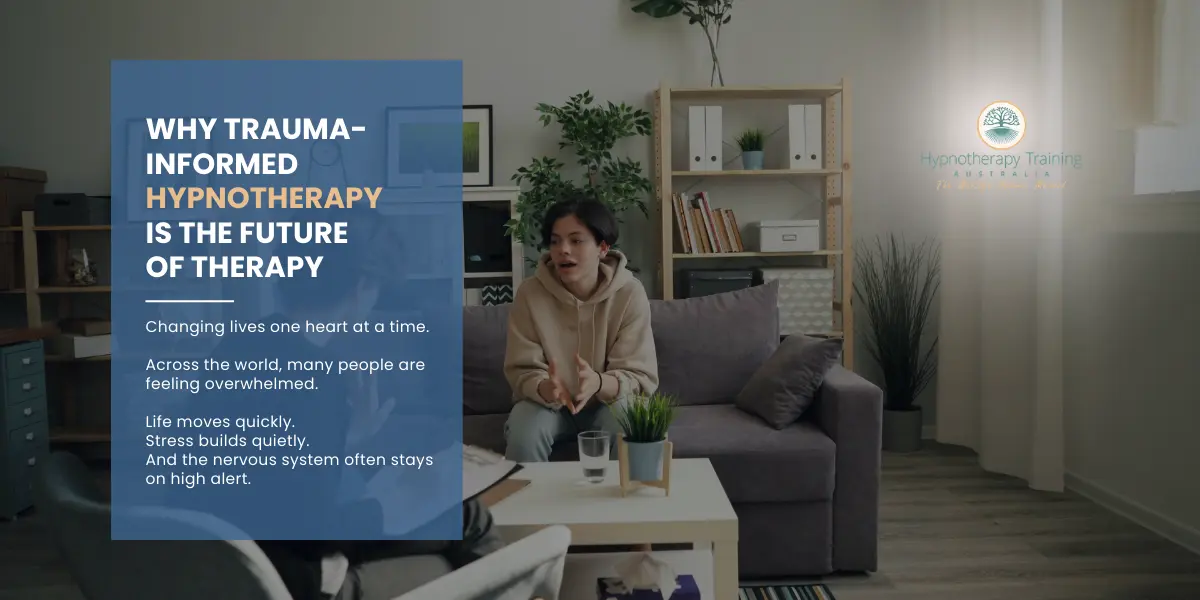
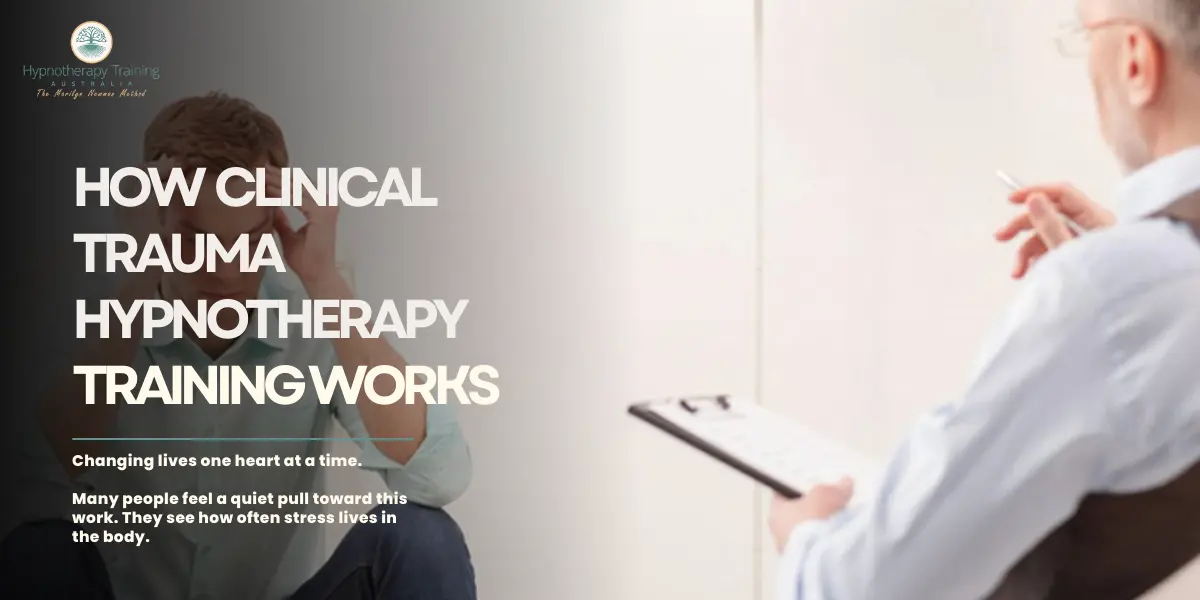
Changing lives one heart at a time.
Across Australia, many people feel trapped in stress.
Their body reacts before they can think.
Their heart races.
Their breath becomes shallow.
They feel alert even when nothing is wrong.
For some, this has been happening for years.
And at the same time, more people are feeling called to help.
They see how many nervous systems are tired, tense, and overwhelmed.
They want a way to support change that is gentle, respectful, and safe.
Trauma-informed hypnotherapy offers exactly that. It provides a calm, heart-centred path back toward steadiness for those who are struggling… and a meaningful way of working for those who want to become practitioners.
What the Stress Response Really Is — In Simple Words
The stress response is the body’s protection system.
It turns on automatically when something feels unsafe.
Heart rate rises.
Muscles tighten.
Breathing changes.
Attention narrows.
For short moments, this can be helpful.
But when someone has lived through trauma or long periods of pressure, the system can stay switched on.
The brain begins to expect danger. The nervous system prepares for threat, even during ordinary life.
Trauma-informed hypnotherapy understands this. It works gently with the brain and body so they can learn that safety is possible again.
There is no force.
No pressure.
No need to relive the past.
Just slow, steady support.
How Trauma Shapes the Brain and Nervous System
When stress happens again and again, patterns form. The brain becomes quicker to react. The body becomes faster to protect.
People might notice:
- racing or looping thoughts
- tight chest or shallow breathing
- panic that appears suddenly
- freeze or shutdown
- dissociation
- difficulty resting
- constant alertness
- emotional numbness
These reactions are not weakness. They are the body’s way of trying to survive. Trauma-informed hypnotherapy meets this protective system with respect.
Why Emotional Safety Changes Everything
A nervous system cannot learn while it feels threatened. If someone is pushed too fast, asked too many questions, or made to revisit painful experiences, the body tightens again.
So trauma-informed work begins somewhere else. With safety.
This means:
- no retelling or reliving trauma
- no force
- no pressure
- the person stays in control
- pacing is slow and steady
- grounding comes first
When the body begins to feel safe… the brain becomes more flexible. And this is where rewiring can begin.
How Trauma-Informed Hypnotherapy Helps the Brain Learn Calm
The brain is always learning. It learns fear through repetition. And it can learn safety through repetition too. Hypnotherapy provides a focused, relaxed state where new experiences of calm can register more deeply. It supports change through:
Subconscious Support
Protective patterns can soften when the mind feels secure.
Nervous-System Regulation
Breathing, tone, and pacing guide the body out of survival mode.
Grounded Awareness
The person remains present and supported.
Deep Relaxation
The brain experiences what it feels like to rest again.
Gentle Repetition
Calm becomes familiar. And familiarity builds new pathways.
This is how the stress response begins to shift.
The DeTrauma Technique — A Structured Way to Support Rewiring
Within training, students are introduced to the DeTrauma Technique.
This approach is designed specifically to release emotional intensity while maintaining strong safety.
It works with:
- subconscious patterns
- nervous-system activation
- grounding and stabilisation
Without story retelling. People often say they feel:
- calmer
- lighter
- more settled
- emotionally balanced
- safe in their body
For students, this creates clarity.
There is a map.
A structure.
A reliable way forward.
Why Practitioners Who Understand the Stress Response Are Needed
More people are living with nervous systems that feel stretched beyond capacity.
They are searching for:
- steadiness
- reassurance
- kindness
- understanding
- a calm presence
They want someone who will not rush them. Someone who understands why the body reacts the way it does. Trauma-aware practitioners bring exactly this. And the need continues to grow.
What You Learn in Trauma-Informed Hypnotherapy Training
Training is designed to build confidence gradually.
Students learn:
Understanding the Stress System
how the brain and nervous system respond to threat
why patterns repeat
how protection becomes habit
Emotional Safety
how to slow sessions
how to create trust
how to avoid overwhelm
Subconscious Processes
gentle hypnotic approaches
supporting new experiences of calm
Grounding Skills
bringing the person back to steadiness
supporting regulation in real time
Personal Development
Many students feel their own stress responses soften as they learn.
They become more present.
More grounded.
More confident.
And that presence becomes part of their work.
Is This Path Right for You?
You might be wondering:
Can I learn this if I’m completely new?
Can I really help people with deep stress?
Will I be supported while I learn?
Can I move step by step?
Can I build a meaningful future doing this?
The answer is yes.
You can learn safely.
You can build skill gradually.
You can be supported at every stage.
If you feel called to help others find steadiness again… if you want to work in a way that is heart-centred and respectful…
We would love to walk beside you.
You’re welcome to explore the training, speak with the team, and move forward when it feels right — with Care and Understanding, as we continue changing lives one heart at a time.

Leave A Comment
You must be logged in to post a comment.