
Changing lives one heart at a time.
Many people explore online hypnotherapy training because they want work that feels meaningful. You may be starting a new career or adding hypnotherapy to your existing professional skills.
You may also feel drawn to this work through personal experience. Perhaps you have seen how trauma, stress, grief, anxiety, PTSD, or emotional overwhelm can affect someone’s thoughts, body, confidence, and daily life.
However, choosing to study from home naturally raises important questions.
Can hypnotherapy really be learned online? Can practical skills develop through virtual classes? Will trainers provide genuine support? Can trauma-aware methods be taught without leaving students alone with difficult material?
The answer can be yes.
Online hypnotherapy training can offer a safe and meaningful learning pathway when it includes structured theory, live interactive classes, practical development, trainer guidance, suitable assessment, and clear professional boundaries.
The learning may happen at home, but students should never feel they are learning alone.
What Does Online Hypnotherapy Training Involve?
Online hypnotherapy training allows students to study theory and develop practical skills without regularly travelling to a physical classroom.
However, online courses can differ greatly.
Some programs mainly offer recorded videos, downloadable scripts, and short quizzes. These resources may introduce basic ideas, but they do not always provide enough interaction for someone preparing to support real clients.
Professional training should offer more than information. Students also need opportunities to ask questions, observe experienced trainers, develop communication skills, receive feedback, and understand their ethical responsibilities.
A well-structured online course may include:
- Structured online theory
- Live virtual classes
- Practical demonstrations
- Guided skills development
- Trainer feedback
- Case discussions
- Assessments
- Mentoring
- Reflective learning
- Professional and ethical guidance
Hypnotherapy Training Australia uses a blended online model that includes structured theory, regular live Zoom practical classes, and supervised clinical development.
This structure is important because hypnotherapy cannot be learned through memorising scripts alone. Students need to understand how to communicate, listen, respond, and work within appropriate professional limits.
Can Hypnotherapy Be Learned Safely From Home?
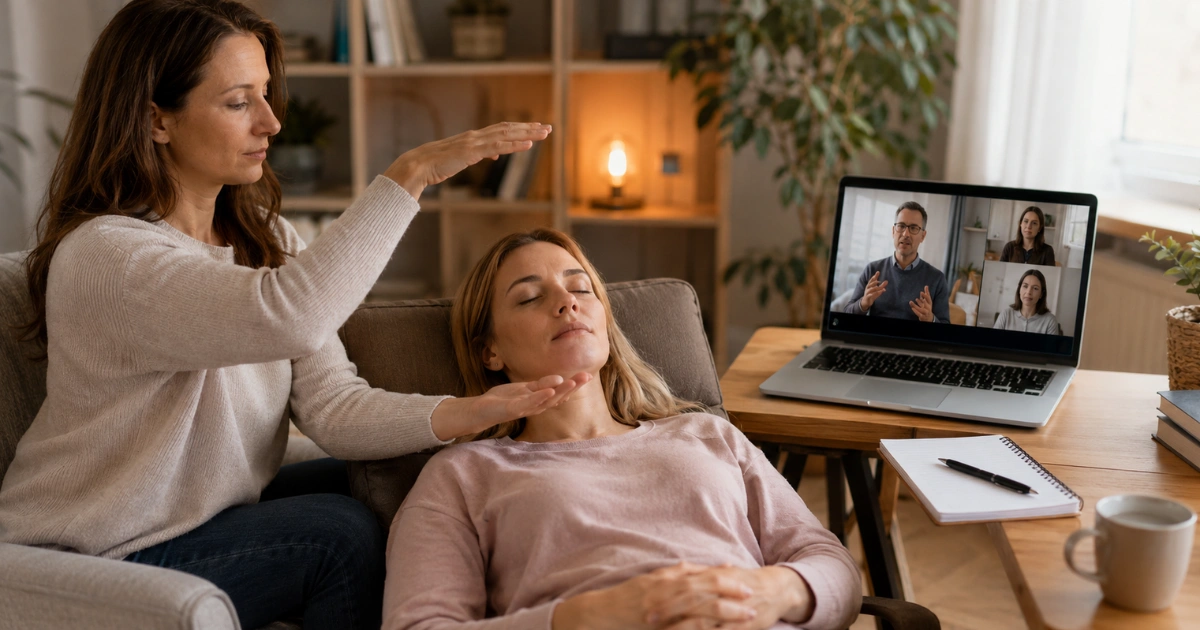
Studying from home can be safe when the course provides suitable structure and support.
Safety does not come from the location alone. An in-person course is not automatically safe, just as an online course is not automatically unsafe.
The quality of the education matters most.
Students should have clear lessons, experienced trainers, live communication, practical guidance, opportunities to ask questions, and support when something feels unclear or challenging.
Safe online education should also help students understand:
- Informed consent
- Confidentiality
- Professional boundaries
- Scope of practice
- Contraindications
- Record keeping
- Referral responsibilities
- Ethical communication
- Practitioner wellbeing
- The importance of supervision
These areas help students recognise what they can responsibly manage and when another professional may be better suited to support someone.
A responsible practitioner does not try to handle every situation alone. Knowing when to pause, seek supervision, or refer is part of professional competence.
Why Live Online Classes Matter
Self-paced lessons can make education more flexible. However, recorded material should not replace all live contact.
Live classes allow students to ask questions as they arise. They can hear different explanations, watch practical teaching, discuss professional situations, and receive guidance from trainers.
This interaction helps turn information into understanding.
It also gives students space to say when they feel unsure. They do not have to pretend that they understand a method before they are ready to use it.
Live learning may help students develop:
- Clear and calm communication
- Suitable voice pace and language
- Active listening
- Session structure
- Professional confidence
- Awareness of client comfort
- Respect for consent and boundaries
- The ability to respond rather than simply follow a script
HTA’s recognised training profile describes its program as fully supported live Zoom education with mentoring and a trauma-focused approach.
This means online students are not limited to reading lessons independently. The training includes real-time contact and continued professional guidance.
How Can Practical Skills Develop Online?
Practical experience is one of the most important parts of hypnotherapy education.
Students need to practise how they explain hypnosis, gather suitable information, guide focused attention, communicate suggestions, and bring a session to a safe close.
They must also learn how to notice changes in someone’s communication, breathing, comfort, attention, and emotional response.
Online practical development can be effective because hypnotherapy is largely communication-based. Video technology allows students and trainers to see facial expressions, hear vocal changes, and discuss how language affects the experience.
A suitable online program should gradually move students from understanding a concept to applying it responsibly.
The process may involve watching a method, discussing its purpose, practising relevant skills, receiving feedback, and reflecting on what could be improved.
This gradual development matters. Confidence should grow alongside competence rather than replacing it.
Online practice can also prepare students for modern professional work. Many practitioners now provide suitable sessions online, so learning to communicate clearly through video can become a useful professional skill.
However, practical development still needs privacy, consent, boundaries, trainer access, and appropriate supervision.
Students should not be expected to manage emotionally complex situations without guidance.
How Does Trauma-Aware Training Support Safety?
Trauma-aware education is especially important when students may later support people affected by trauma, PTSD, grief, anxiety, chronic stress, or emotional overwhelm.
Trauma can affect more than someone’s memories. It may also influence their nervous system, emotional responses, physical tension, sense of safety, and ability to remain present.
When the nervous system senses danger, a person may experience automatic protective responses. These can include fighting, escaping, freezing, shutting down, becoming highly alert, or feeling disconnected.
These responses are not personal failures. They may be the body’s attempt to protect itself.
A trauma-aware practitioner should therefore avoid rushing, forcing, blaming, or demanding unnecessary details. The person receiving support should remain involved in decisions about pace and direction.
Students need to understand the importance of:
- Emotional safety
- Client choice
- Gentle pacing
- Grounding
- Present-moment awareness
- Clear communication
- Consent
- Professional limits
- Supervision and referral
These skills cannot be developed by reading a single script.
They require explanation, discussion, observation, guided practice, feedback, and time for reflection. A carefully structured online environment can provide these elements through live teaching and supervised development.
Emotional Safety During Online Learning

Trauma-aware training may include material that feels personally meaningful for some students. A learner may recognise patterns from their own life or feel emotionally affected by a class discussion.
This does not mean students should be encouraged to disclose private experiences without boundaries.
A safe learning environment respects personal choice. Students should not feel pressured to reveal painful details or use deeply distressing experiences during classroom practice.
They should be able to pause, ask questions, take an appropriate break, and seek support when necessary.
Students also need to understand the difference between professional training and personal therapy. Education can encourage reflection, but a classroom should not replace individual therapeutic or medical support when that support is needed.
Trainer guidance, clear expectations, respectful communication, and suitable boundaries help make online learning more emotionally manageable.
The goal is not to remove every challenging moment. The goal is to provide enough structure and support for students to learn responsibly.
Creating a Suitable Learning Space at Home
A student’s physical environment can affect privacy, concentration, and participation.
You do not need a large private office or expensive equipment. However, you should have a space where you can attend live classes without frequent interruptions.
A suitable home-learning setup may include:
- A quiet and reasonably private room
- A reliable internet connection
- A computer with a working camera and microphone
- Headphones when additional privacy is needed
- Enough lighting for clear video communication
- Secure storage for course notes
- Water and suitable breaks during longer classes
- Reduced phone and household interruptions
Privacy becomes especially important during practical learning and case discussions. Other students’ personal information or classroom contributions should not be recorded, shared, or discussed outside the approved learning environment.
Students should also avoid attending sensitive classes from public places where conversations can be overheard.
Creating clear study times can help as well. Online flexibility is useful, but substantial professional education still requires attention, preparation, practice, and reflection.
What Should Students Expect From Trainers?
Online students should know where to turn when they need help.
Trainer support may be required when a student does not understand a method, feels uncertain about a professional boundary, struggles with practical communication, or needs feedback about their development.
A supportive trainer does more than provide answers. They help students think carefully about why a method is used, when it may be unsuitable, and how it connects with ethical practice.
Students should feel able to ask:
- Why is this method being used?
- What are its professional limits?
- How should consent be discussed?
- What should happen if someone becomes uncomfortable?
- When should the session pause?
- When is supervision needed?
- When should another professional be involved?
These questions help students develop judgement rather than relying only on instructions.
Mentoring can also support the move from learning theory to thinking like a responsible practitioner. It gives students opportunities to discuss uncertainty before working independently.
Is Online Hypnotherapy Training Recognised in Australia?
Online delivery does not automatically determine whether a course is professionally recognised.
Recognition depends on the exact program, its educational content, total hours, interactive learning, practical development, assessments, counselling or psychology content, and the standards of the relevant professional association.
The Australian Hypnotherapists Association lists Hypnotherapy Training Australia’s Advanced Diploma in Clinical Trauma Hypnotherapy & Psychotherapy as a recognised course containing 1,528 education hours. It is listed for online delivery across Australia and internationally.
The AHA describes the recognised course as a 12-to-18-month program with fully supported live Zoom training, mentoring, and trauma-focused education.
Students seeking AHA Graduate Membership currently need to complete a hypnotherapy course containing at least 1,000 hours. That education must include at least 110 hours of basic counselling or psychology processes.
HTA’s recognised 1,528-hour course exceeds that minimum education requirement.
However, students should always check the exact course title before enrolling. Recognition of one program does not automatically apply to every short course, workshop, or certificate offered by the same provider.
Professional association recognition should also not be confused with a compulsory government licence. Hypnotherapy is a self-regulated profession in Australia, so suitable education, association standards, ethics, supervision, insurance, and continuing development remain important.
The DeTrauma Technique Within HTA Training
The DeTrauma Technique forms part of HTA’s trauma-focused education.
The AHA’s profile for HTA identifies the technique as part of the recognised training program.
Its place within the course supports HTA’s wider focus on trauma-aware learning. However, professional preparation should never depend on one technique alone.
Students still need a broader understanding of communication, counselling processes, nervous-system responses, ethics, boundaries, informed consent, scope of practice, supervision, and referral.
A structured method can provide direction. Professional judgement develops through the wider course, guided practice, feedback, and continued learning.
What Should You Check Before Enrolling?
Before choosing an online hypnotherapy course, look beyond promises about convenience or fast completion.
Ask the training provider:
Is the exact course professionally recognised?
Check the full course title against the professional association’s current directory. Do not rely only on the school’s general recognition.
Does the course include live teaching?
Find out whether you can interact with trainers, ask questions, and participate in practical learning.
How are practical skills developed?
Ask how students move from theory into guided professional application.
Is trainer feedback available?
Students need more than automated quiz results. They should receive meaningful guidance about their understanding and practical development.
Does the course cover trauma awareness?
Look for education about emotional safety, nervous-system responses, pacing, grounding, consent, boundaries, scope, supervision, and referral.
How is student privacy protected?
Ask about expectations for live classes, practical activities, case discussions, recordings, and the handling of learning materials.
What happens when a student needs support?
The provider should explain how students can contact trainers and receive help with challenging material.
How long does the course take?
Be cautious about programs promising complete professional competence within an unusually short period. Students need time to understand, practise, reflect, and improve.
A suitable provider should answer these questions clearly without pressuring you to enrol.
Who May Benefit From Online Training?
Online hypnotherapy training may suit people who cannot regularly travel to a physical training centre.
It can be helpful for:
- Students living in regional or remote areas
- People balancing study with employment
- Parents and carers with limited travel options
- Existing practitioners expanding their skills
- Career changers seeking structured professional education
- Students who learn well within a familiar environment
- People wanting access to trainers outside their local area
Studying from home can reduce travel and make professional education more accessible.
However, flexibility does not mean the course requires little commitment. Students still need to attend required live classes, complete theory, participate in practical learning, meet assessment standards, and make time for reflection.
Online learning works best when students approach it as genuine professional training rather than casual home study.
Can You Learn Safely From Home?
Yes, hypnotherapy can be learned safely from home when the course is properly designed and professionally supported.
The strongest online programs do not leave students with recorded videos and scripts. They combine theory with live teaching, practical development, feedback, mentoring, emotional safety, and clear professional standards.
HTA provides structured online theory, regular live Zoom practical classes, supervised clinical development, and mentoring. Its AHA-recognised Advanced Diploma in Clinical Trauma Hypnotherapy & Psychotherapy contains 1,528 education hours and is listed for online delivery throughout Australia and internationally.
This provides students with flexibility without removing interaction or professional responsibility.
Before enrolling, check the exact course, live-class structure, practical learning, trainer support, trauma-aware content, education hours, and professional recognition.
Choose training that lets you study from home without leaving you to learn alone.
Changing lives one heart at a time.
Frequently Asked Questions
What is the best online hypnotherapy training course in Australia?
A strong online hypnotherapy course should provide real contact with trainers and regular practical learning. Look for live teaching, opportunities to practise and accessible support when questions arise. HTA combines independent study with live classes and lifetime membership, so the connection with the training community continues after graduation.
Can I become a qualified hypnotherapist through online training?
Professional hypnotherapy education can be completed online when the program provides sufficient depth and meets appropriate standards.
What matters is how the online format is used. HTA combines theory with scheduled live
learning, allowing students to develop interpersonal skills while completing the course remotely.
What is the difference between self-paced online courses and live online hypnotherapy training?
Self-paced study is useful for absorbing theory at a convenient time. Live learning serves a different purpose because students must respond to people and situations as they happen.
That real-time element matters in therapeutic education. HTA uses both approaches, giving students flexibility without expecting them to develop practitioner skills entirely on their own.
How does live online hypnotherapy training work?
Live online training brings the class together through Zoom at scheduled times. A session may include explanation, a demonstration, discussion or practical work with classmates. Questions can be explored while the topic is still being worked through.
Can online students interact directly with trainers and other learners?
Direct contact is part of HTA’s online learning model. Trainers and classmates meet regularly during live sessions, so people are not studying anonymously behind a screen. Familiarity builds naturally through repeated classes, and some of those connections continue after the course.
How do students practise hypnotherapy skills during online training?
Practice takes place with classmates during scheduled live sessions. Working with different people quickly shows that the same technique will not produce an identical experience every time. A change in wording, timing or tone can become something to explore in the next
attempt.
What support do students receive throughout an online hypnotherapy course?
HTA provides access to trainers and mentoring throughout the online course. Support may involve a difficult concept, practical work or a professional question. Lifetime membership continues that connection after graduation.
Can I study hypnotherapy online while still feeling connected to a learning community?
Yes. HTA’s live classes give learners regular contact with the same trainers and classmates. Shared practice, discussions and questions create familiarity, which helps an online class develop into an actual learning community.
Is online hypnotherapy training as good as in-person training?
Quality depends more on the design of the education than the physical location of the classroom.
A strong online program can still provide discussion, observation and interpersonal practice. It also introduces students to communicating therapeutically through a screen, which can be useful for practitioners who later work with online clients.








Leave A Comment
You must be logged in to post a comment.